Artificial Intelligence is producing content at an astounding rate. What are we to do with it?
For every question I ask, My AI produces 10 pages of text. Millions use AI. Do the math.
Knowledge from Ancient Greeks comprises by far the greatest part of the legacy of bygone civilisations. That's thanks to centuries of transmission: transcribing, rewriting, considering, incorporating. But given the sheer size and scale of AI produced content, how are future civilisations ever to know where to start?
I ask My AI. As expected, I get boilerplate. But I then ask My AI to calculate the relationship between the volume of my questions and the answers it gives:
“In this exchange, your questions averaged 230 characters, while my answers averaged 4,392 characters, making my responses about 26 times longer.”
My point being, at the current rate, it won't be long before data storage and retrieval gets overwhelmed.
Some sources project that global data generation could reach 75,000 zettabytes by 2040. How to even envision such a volume?
When I was a malleable student, I was taught weird and wonderful theories that shaped my unformed young brain. Among them, the concept of the Noosphere by the philosopher-priest Teilhard de Chardin.
The concept uses the atmosphere of planet earth as a rhetorical tool: troposphere, stratosphere, mesosphere. Or, similarly, the geologic sphere, the geosphere, and the biosphere. Above those, says Teilhard de Chardin, is then the Noosphere, an encompassing veil of human knowledge that sits over our planet.
The theory then veers off into teleological blather, says my hardened present self. Teilhard explains that the Noosphere is moving toward the Omega Point, the final evolutionary stage, with the help of science. Reminds you of Ray Kurzweil and his Singularity, maybe?
It’s the metaphor that interests me, not the pseudo-scientific grounding, for which, by the way, he and his works were condemned by the Catholic Church.
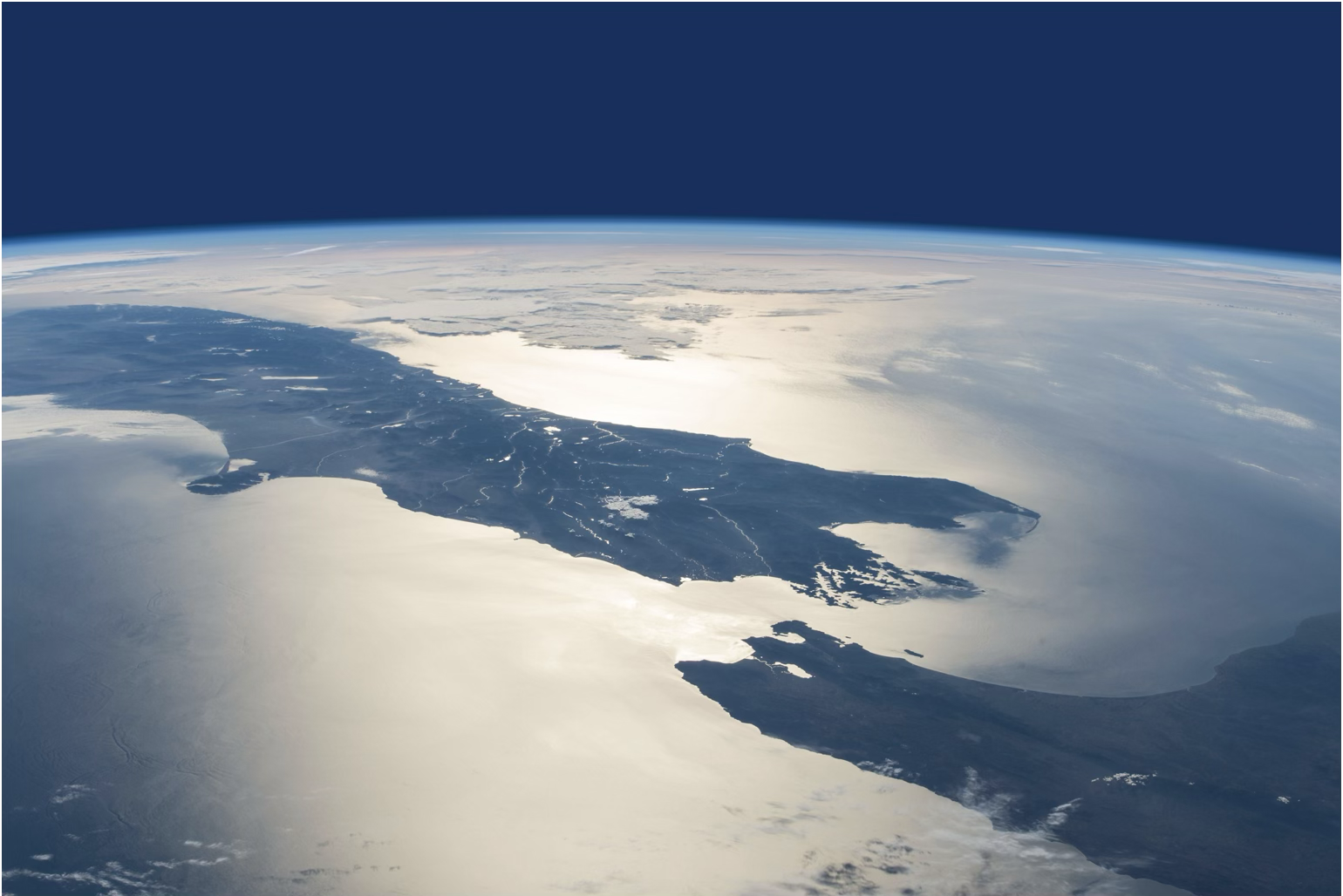
Think of pictures of the earth as seen from the ISS. The atmosphere barely visible.
If the Noosphere were to be pictured in 1955, the year of Teilhard’s death, it’s a layer above the atmosphere so thin it could be mistaken for the shimmer of the aurora, a fragile sphere of human consciousness.
Fast forward to 2025, it's ballooned to encompass most of the inner solar system, so large that even My AI breaks into poetry: “It’s no longer a veil but a dense, turbulent nebula, stretching millions of kilometers into space. A chaotic cloud of data, algorithms, and digital detritus. Instead of a harmonious sphere, it’s a swirling, opaque fog: part library, part landfill, part hallucination.”
And by 2040, I hesitate to ask?
“No longer a sphere, but a fractal labyrinth, dense in some regions: corporate data fortresses, social media black holes, threadbare in others: lost archives, dead links, forgotten cultures. Parts of it would be alive with real-time thought and creativity, while vast swaths would be dead zones of obsolete formats, corrupted files, and AI-generated nonsense.”
God, My AI really can write.