Five Pivots Software Development Made That AI Could Never Have Imagined.
How to remain innovative when you let AI take away the struggles of production.
My AI coding agent writes code ten times faster than I could ever do. It can do that because it’s read all the code on the internet.
It has extracted patterns from every solution; the rules by which it approaches problems have been extracted from decades of programming practice.
And that’s enough for most of us. We have the world’s solutions at our fingertips; with that we can create fabulous new apps in a fraction of the time.
But how is software development itself going to develop when all we ever do is work with the same patterns and the same approaches devs have been doing for decades?
———————-
Here’s five pivotal moments in software development that changed the industry dramatically, but AI could never have come up with.
———————-
1️⃣ OBJECT-ORIENTED PROGRAMMING, bundling code and data together into “objects”. Languages like Python were a paradigm shift from the linear, procedural languages of the time. Enabling complex systems like GUIs, game engines, and modern frameworks.
2️⃣ THE INTERNET. Tim Berners-Lee imagined a decentralised, hypertext-based system for sharing information globally. Democratised information, made the internet economy possible, and gave billions access to software in the form of SaaS solutions.
3️⃣ OPEN SOURCE SOFTWARE, the idea that code could be freely shared, modified, and improved by anyone was radical. It challenges the proprietary software model, giving rise to collaboration at a huge scale. Open source software powers the internet.
4️⃣ AGILE AND DEVOPS prioritised adaptability and human collaboration over rigid processes. DevOps broke down silos between development and operations, automating workflows but also emphasising culture and shared responsibility.
5️⃣ THE UNIX PHILOSOPHY underlies the internet at large, starting with the most minute details. Its about how modular command line programs, created in isolation, pipe their results to each other, inspired modern microservices, APIs, and the composability that powers cloud computing.
Why couldn’t AI have come up with these innovations?
Because each of these pivots are not more of the same. They’re cultural shifts incentivised from deep within: gut feelings, the lizard brain, combined with high awareness of the changing needs of humans in a volatile environment.
———————-
The most brilliant inventions are about finding a pattern before there’s a pattern.
———————-
I was reading BusinessWeek columnist and former professor Roger Martin this morning where he gives examples of effective cost control strategies: Costco only stocking high turnover items, Ikea choosing not to assemble furniture but instead shipping flatpacks.
The secret of Costco’s cost-effective success is that it only stocks articles that are sold very quickly, leaving aside an entire category of goods. Many competitors stock a wide variety, including higher priced low turnover articles, which hog shelf space and thus lower revenue per meter.
Our own Ikea is a more comfortable example, one we grew up with here in Europe. We don’t know better than that you buy cupboards and cabinets from Ikea as flatpack and assemble yourself. Our home is filled with Ikea. I pride myself in being an Ikea assembling expert.
That shipping your product as flatpack is a paradigm shift didn’t occur to me until I read Roger Martin. But so it is. Again, leaving behind an entire category for competitors to explore.
The key insight? Ikea and Costco succeeded because they identified what could be left out of an already successful model; from the traditional furniture industry shipping assembled goods, Ikea learned assembly could be done by customers; Costco decided to only offer that which everyone wanted, leaving others to handle the slow-moving niche.
What they did is the opposite of following a pattern. They found an anti-pattern.
———————-
Pattern recognition is the easy stuff. But AI is missing the organs needed to jump out of the pattern and into the anti-pattern.
———————-
Why pattern recognition jobs are at risk is because AI is excellent at following and filling patterns.
The thing about innovation is that it isn’t derived from theory (unless it’s theory itself) but from practitioners. Innovation emerges from the messy, the unpredictable. The anti-pattern.
How to imagine AI being a practitioner? You would have to endow AI with some form of human drive, which is something we might want to avoid. Even it’s at all possible.
———————-
How to get messy when Your AI does all the digging.
———————-
Even if there are ways to circumvent the practitioner problem, the core remains: how to incentivise real innovation when we as humans are so far removed from practice?
Real innovation comes from urges originating in our “lizard brain”, but the urge (frustration, struggle, excitement, love) is triggered by the being in touch with the reality of practice.
The next big thing is to be born from the constraints of practice, but if all we see is results, where’s the trigger coming from?
AI-less Fridays? Celebrating hacks, workarounds, and duct-tape fixes that reveal deeper insights?
The next big thing won’t come from AI, but from humans who are deeply embedded in practice, who are in love with the problems and with the solutions, with AI as their amplifier.
The challenge is to design a workflow where AI handles the drudgery and exposes the meaningful struggles.
The ones that trigger the lizard brain.
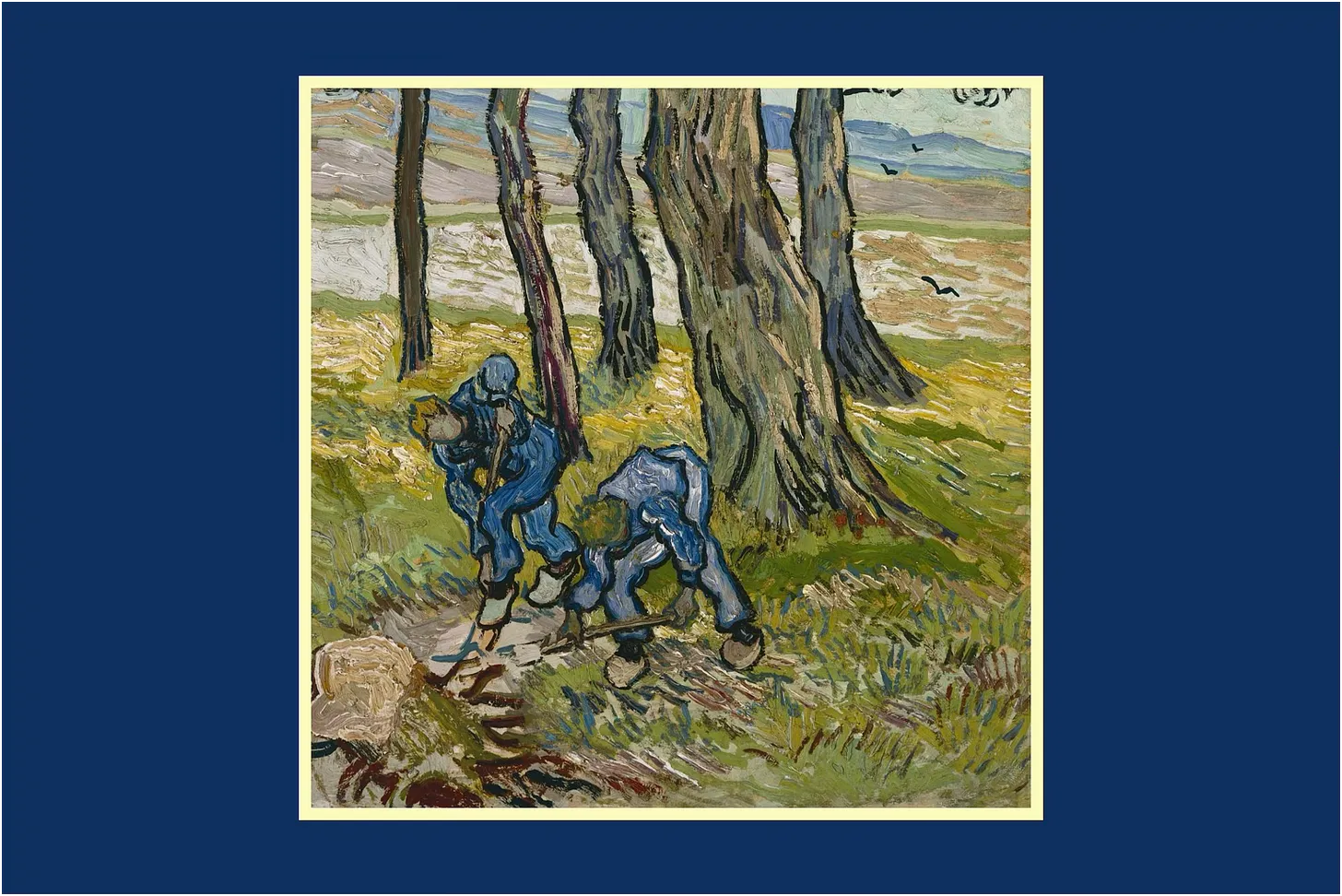
Header image: Two Diggers among Trees, Vincent Van Gogh, 1889.