For AI, time doesn’t exist. Nor does the world and everything we love.
We don’t need AI to have feelings, we have more than enough of our own. But if time doesn’t exist for AI, it does for us. It’s how we make money.
We’re a small software company in the process of automating all our processes using AI. Central to that effort is working with AI coding agents.
If I leave my agent mid-session, I have to overcome my tendency to explain. My human understanding of time makes me think My AI experiences time like I do. Gets bored while waiting. Ridiculous. For My AI, time doesn’t exist.
But for us, time most certainly exists. We always have too little of it. We live by the clock. We sell our working hours to the highest bidder.
We sell our time by the hour but now AI is taking our time from us.
Dario Amodei, CEO of Anthropic, imagines that AI will have an enormous impact on the economy and the world at large. Sooner rather than later. His timeframe is in the order of months.
It’s becoming increasingly clear that AI is going to replace millions of white-collar jobs. Every job that involves repetitive intellectual tasks is at risk. And that’s going to be a game changer for the west, where manual labour has been offloaded to developing countries in the past decades.
For once in his life, something Trump has said contains a grain of truth. Hidden beneath his call for the US to return to the industrial hegemony it once was, is a real crisis in the making. Because his simultaneous support for AI is going to decimate the service industry that has since replaced US industry.
What’s going to happen to all those displaced office workers? They can’t all go work in the remnants of the increasingly automated industry. They don’t all have the skills to work in construction or other technical roles.
Helen Edwards of the Artificiality Institute is clear. Increased productivity from AI is driving prices up in unrelated sectors while intellectual workers are driven into poverty.
How does that rhyme? AI innovation saving time but who’ll be left to buy?
Helen Edwards’ point is this: if AI makes everything more efficient but also concentrates wealth and purchasing power in fewer hands, who will buy the products and services that drive the economy?
The Industrial Revolution created new jobs, but the transition was painful and required massive societal adaptations. The speed and scale of AI disruption may not allow for such gradual adjustments. Not if Dario Amodei is even halfway right about his predictions.
Not everyone can or wants to become a data scientist, electrician, or nurse. The challenge isn’t just technical training; it’s also about identity, purpose, and the social fabric that work provides.
The end of the service economy has society falling off a cliff.
AI brings unprecedented productivity gains, but productivity gains don’t automatically translate into shared prosperity.
The scenario where a small elite benefits from AI-driven efficiency while everyone else struggles to afford the basics is hard to understand when there’s nobody there to buy what the elites are selling.
Trump’s industrial nostalgia is a symptom of deeper anxieties. There’s real question behind the nostalgia for bringing back factories; but the question is rather what comes after the service economy when AI has replaced service workers. It seems highly unlikely that enough high-value, creative jobs will be created to offset the expected losses.
Time is money, they say, but what if we have too much time and too little money?
Marx says surplus value comes exclusively from labour, as labour is the only variable capital. Workers spend their wages on housing and other amenities that spread economic value across the community.
But increasingly, human labour has been taken over by machines, which is fixed capital, not variable. Yes, there is still some residue of variable capital there, as the automation is still built by workers, but that’s a one-time thing, after which value from workers ends.
Once upon a time, workers could sell their time to the boss. They’d get their weekly wage in an envelope, the boss would get their surplus value.
But that’s changed dramatically over the past century, and now, with the coming of AI, changing dramatically faster than ever.
That’s the puzzle to be solved: how is surplus value created in a 21st century permeated by AI?
Marx argued that surplus value arises from variable capital (labour), not fixed capital (machines, tools). Workers are paid a wage, produce more value than they consume, and the difference is captured as profit by capital owners. Machines, in his view, only transfer their own value to the final product, they don’t create new value.
AI and automation are the ultimate fixed capital. Once built, they can produce value indefinitely with minimal ongoing labour input. The "one-time" labour of building the AI (or factory, or robot) is amortised over vast outputs, reducing the share of variable capital in each unit of production.
If an AI system writes code, designs products, or even manages other AIs, where does surplus value come from? Not from the traditional source, human labour. That’s been outsourced to AI.
Workers, now unemployed or underemployed, can’t buy the goods and services AI helps produce.
Ultimately, if surplus value arises from profit, profit arises from sales. With AI driving productivity ever higher, but nobody to sell to, demand collapses, prices come down, surplus value collapses with it.
When AI displaces workers but doesn’t replace their incomes, the engine of capitalism stalls.
Henry Ford famously doubled his workers’ wages so they could afford to buy his cars. This was a deliberate attempt to align production with consumption.
After WWII, Western economies used progressive taxation, unions, and social safety nets to ensure workers could participate in the markets they helped create.
It’s obvious: production needs consumption. Who’s going to buy holidays to the south of France when they’ve just lost their job servicing customers in the travel industry?
If we do it right, small companies like ours might offer a blueprint.
As a software company, we’re acutely aware that our relationship with time is changing.
That change is made abundantly clear when our AI coding agents lay out a plan for a complex refactor or a new feature.
The agent produces a multi-step overview to which the traditional effort is mapped. Week 1, week 2, etc. Yes, indeed, measured in weeks.
It then proceeds to execute the plan in 15 minutes.
So this too is obvious: time is no longer the constraint. Something has changed that is turning the traditional business model of the software industry on its head.
A senior software developer, powered by AI coding agents, with intricate knowledge of both technology and the business domain of the project, can replace a whole team: from product managers, project managers, designers, frontend and backend developers, devops engineers and security experts.
Like the webmaster of the nineties, they could oversee the whole realm of a software product. We're retraining our developers to that end. The name we give that process? Becoming Masters.
Our company is moving from a time & materials based business model to what we call commitment, a subscription model where we support, maintain and improve our clients’ digital products, irrespective of effort, against a fixed monthly sum. We therefore redirect productivity gains from our AI to our clients from which they can create value.
Traditional time & materials business models tie revenue of the software company to labour hours, creating a perverse incentive: the longer the work takes, the more the software company makes. To mitigate this uncertainty, clients and companies alike spend thousands of hours projecting effort in advance, which fails so often most don’t hit the headlines.
We’re taking a radically different approach to the relationship between time, effort and productivity. Through our commitment model, we’re tying ourselves to our clients business far more closely. We’re carrying efficiency gains over into the businesses of our clients by accelerating new features which facilitate new business approaches, which in turn enables them to explore new sources of revenue. Which ultimately helps us both grow.
Niches and high velocity might offer an answer in the post-service economy where software development time is not of the essence.
Recently, a friend told me about the workforce of a family business in the retail supply industry. These were mostly women in their late fifties or early sixties whose job it was to enter orders into their system. As it was described to me, the work was repetitive and simple, but the women loved their work and their team.
To celebrate the occasion of the tenth anniversary of the company, the entire team spent a long weekend in Berlin, sightseeing and spending evenings in a luxury hotel.
For many, the job is their entry pass into community they grow to love.
I realised that women their age might never have a job again if AI would replace them.
With AI moving so fast, it’s obvious that businesses are going to take advantage of it by to do just that.
But there’s also opportunities.
With increasing productivity comes increased velocity. We can create solutions for niche areas of industry that were previously unserviceable.
Areas for which automation seems impossible or unnecessary: the highly valued artisan bakery on the corner has long queues in the weekends, especially if the weather is nice. They’re losing sales, but more staff doesn’t fit into the tiny space. Moving isn’t an option.
Now that time is no longer of the essence we can afford to look into it.
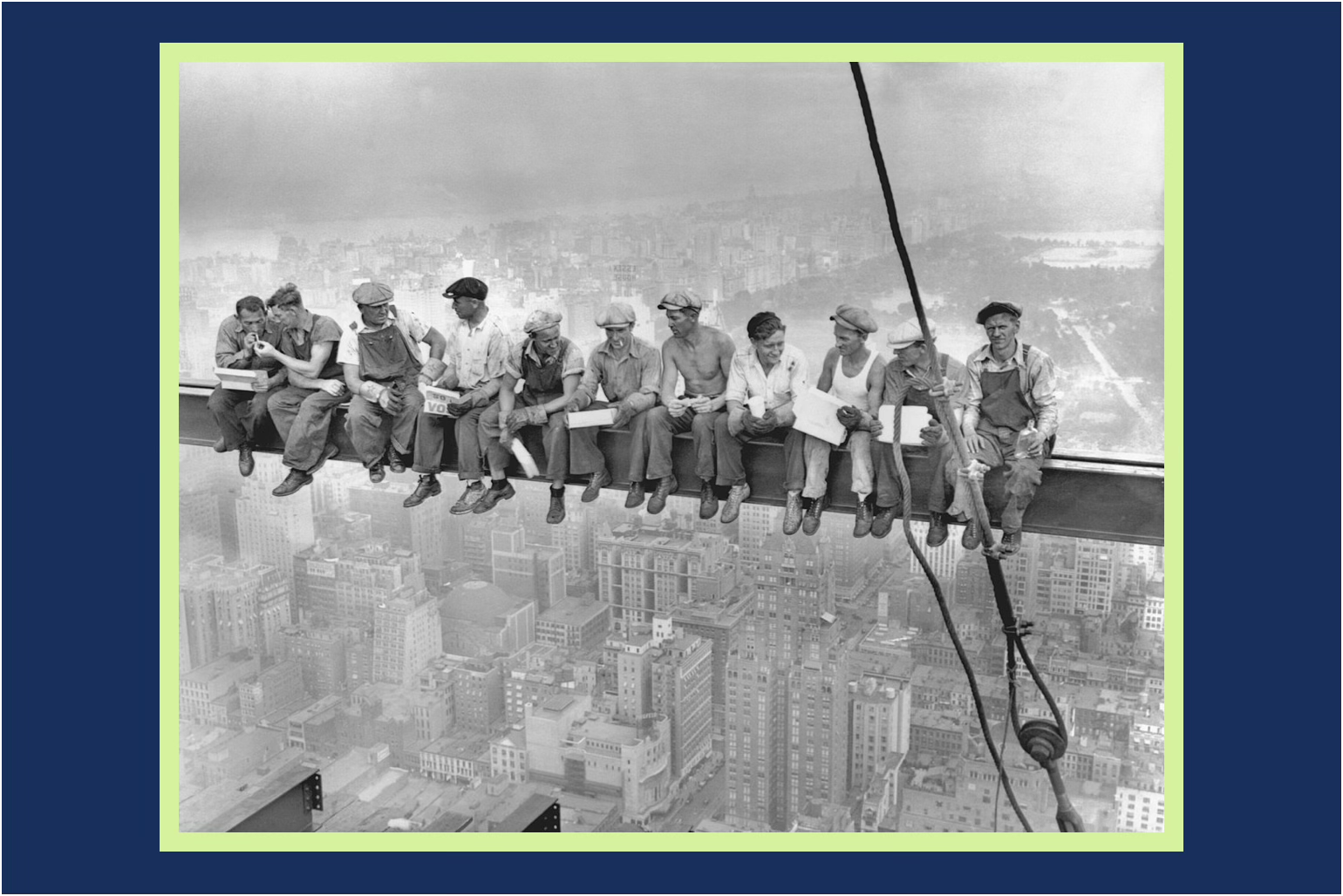
Header image: Charles Clyde Ebbets, “Lunch atop a Skyscraper”, 1923. Workers in the early 20th century lived precarious lives. Workers in the early 21st century no less.