I’m on my way: why we feel our best when we’re moving.
Jeff Hawkins and his team have been working on true Artificial Intelligence for decades.
Right now I’m reading “A Thousand Brains” by the founder of the company behind the Palm Pilot and the current founder of the AI research company Numenta.
If you don’t know what the Palm Pilot is and you’re under 45 you’re forgiven. It was like an iPhone only one-gazzalionth of the power. Saint Steve in heaven took it as their inspiration.
There’s a lot to process in the book. What inspired me today is the idea that movement is at the very core of intelligence.
First the basics. Numenta is investigating human intelligence in order to replicate that in code. Great idea, you might say, but haven’t we already done that? We have ChatGPT, right?
However, the AI that we use, while capable, is very far from being intelligent. It's basically a probability machine, expert at guessing which word should come after another in a response. It gets the job done, but as even Sam Altman admits, the CEO of OpenAI, Artificial GENERAL Intelligence is still a long, long way off.
AGI is precisely what Jeff Hawkins and Numenta is after. For them, the tech behind ChatGPT can’t scale up to true intelligence. We need a better approach.
What sets us mammals apart from reptiles and birds is that in our brains we have a neocortex, which consists of hundreds of thousands of near-identical cortical columns. Together they enable us to navigate through space, map space to our bodies, help us remember where that patch of particularly delicious berries was we came across a month ago. Birds and reptiles have a simpler form of these structures, however smart magpies and crows might seem.
You might call it muscle memory. For myself, it reminds me of a scene in Butch Cassidy & the Sundance Kid, where the kid needs to prove he’s a good shot. After a few misses he asks: “can I move?”.
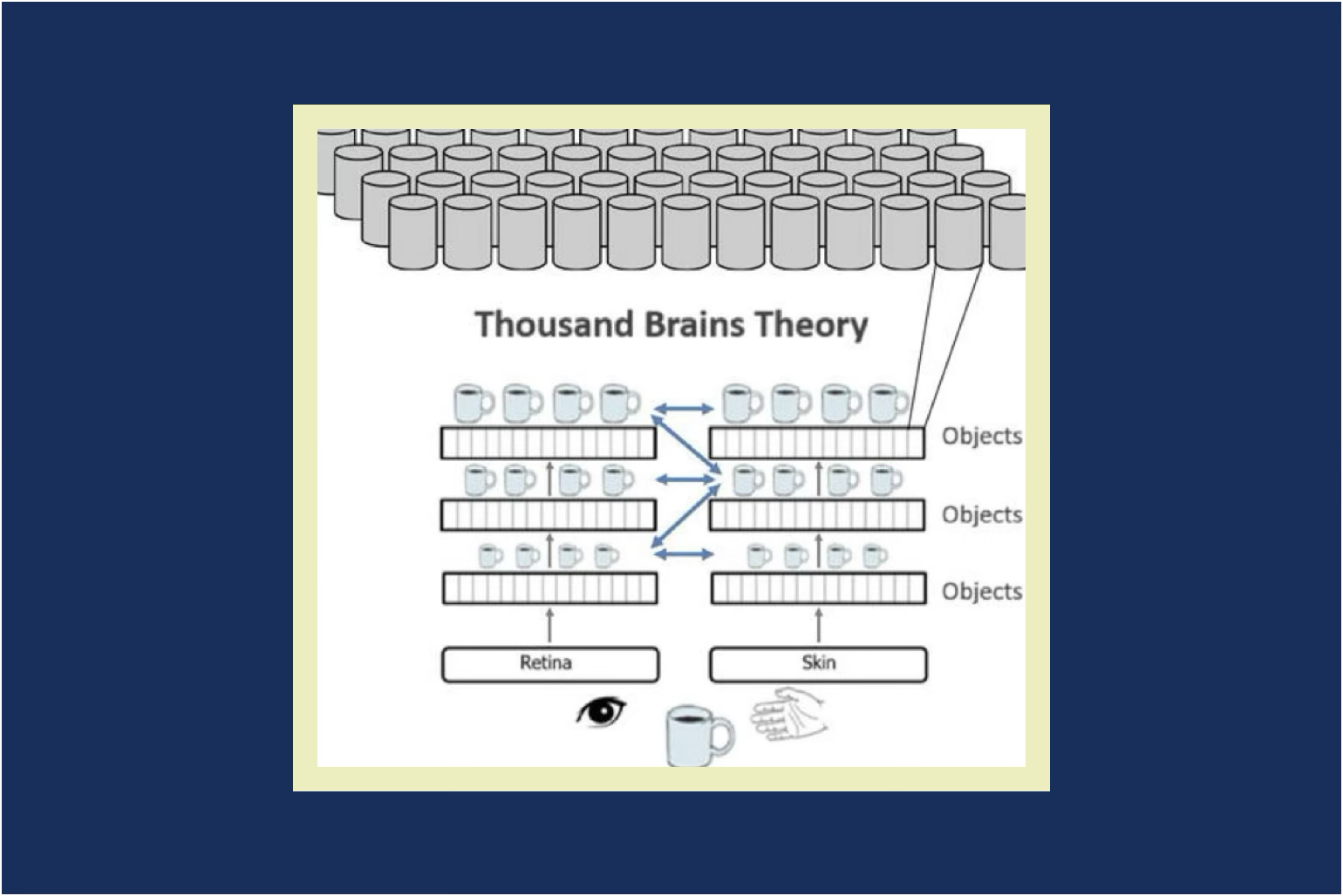
According to Hawkins, and a growing consort of the neuroscience community, movement is at the base of perception, be it sight, hearing or touch. Even when we think we a viewing a static scene, our eyes saccade three times a second. Hearing is perception of sound through time. When we grasp a cup, we run our fingers across the rim to discover its shape.
These movements result in reference frames: 3d maps of objects. The cortical columns of the neocortex create thousands of models of objects in the world, some of them more or less complete, some fragmentary. Some auditory, some visual, some tactile. A “voting system” then creates the big picture.
But the term “big picture” is misleading. Because what is created is how the world is expected to look, feel, sound in the next few seconds. It’s a predictive system, and if reality doesn’t match, we’re surprised.
I’m most happy when I’m moving. In my car, in a plane, moving through airports. Majestic novels are conceived during walks. You remember the thing that has stubbornly eluded you just as you get up to grab a coffee.
I think Hawkins is on to something here.