Lead into Gold: AI researchers still haven’t found their Philosopher’s Stone.
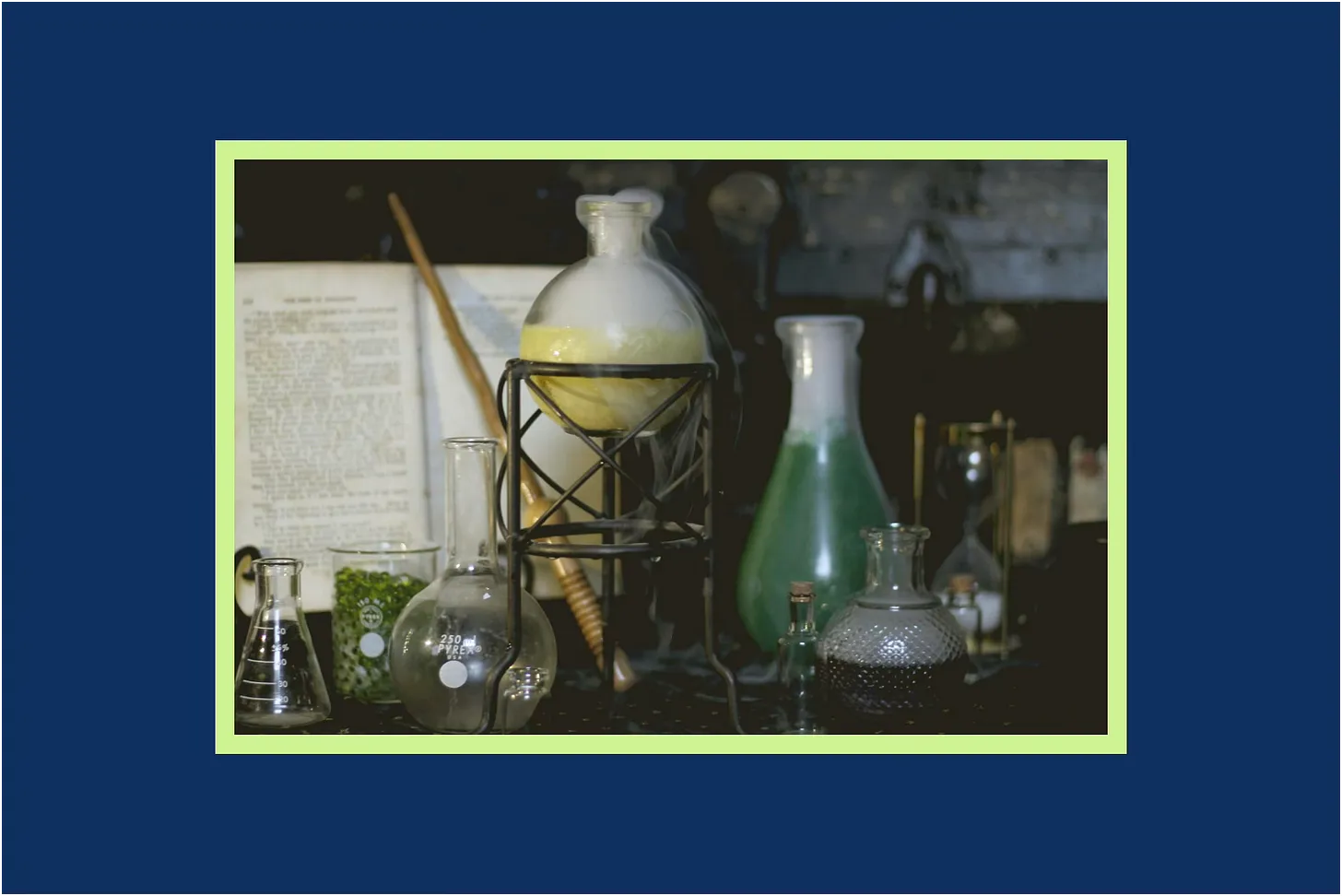
True Artificial Intelligence is the 21st century alchemist’s dream.
Us software developers, we’re data people. All software is about transforming data into something presentable.
A database is — in principle — nothing more than a ledger. Sure, they can get pretty complicated, foreign key relationships, many-to-many, nosql database types that store documents like json files. But, as they store information about the perceived relationship between reality and the inside of people’s minds, ledgers they are.
Ledgers, just so you know, are ancient. The English word is from the Dutch “legger”, a book kept open in one particular place. You can imagine a ledger sitting on a shop counter, open, ready to enter incoming inventory and today’s sales.
But ledgers are more ancient than that. In fact, ledgers start before writing starts. Where numbers of sheaths of corn need to be kept in external memory banks, safely stored outside of the fragile and corruptible human mind. Think 10,000 BC.
Think again. Much earlier. Numbers feature in Deleuze and Guattari’s concept of the war machine in their book “1000 Plateau’s”, where nomads count their steps through the unbounded landscape in a time outside of fences, ownership, and the grain silos of the state.
And what’s counting anyway? Isn’t it the transformation of the absolute into something humans can fathom? And feel? With their feet, their fingers and toes?
Data, like money, can be conjured up out of thin air.
Money is a stream of data through systems. Like all data, it’s saved in databases, but that’s just a number in a ledger, commercial banks are transformative institutions: make money out of thin air by lending it to individuals and companies.
Data in general is not like money data. At some point reality hits: if you’re selling socks and your system says you have ten pairs in your inventory but you don’t, you can’t conjure them up out of thin air.
The internet is different again. It’s one big data store you might say, but no, is a flowing, self-feeding system where every interaction delivers more data in the form of views and clicks saved in logs. Every action you take on the internet is numbered, categorised, located. And saved in databases. Data becomes more data.
Enthralled by the search for the Philosopher’s Stone.
In the world of Python programming, there’s a database application named SQLAlchemy. It’s actually not so much an application but a tool, used for the translation of pure SQL into classes and functions that are more suited to a Python program. And alchemy it is, this turning of the lead of SQL into the gold of the Python programming language.
Transforming lead into gold is an alchemist’s dream. The Philosopher’s Stone is central to such transformations: a mythical and mystical original substance, a first mover. The alchemist experiments with combinations of chemicals in search of this primal material. Once a likely candidate is found, this Projection Powder, as it is called, is then thrown (projected) into a molten base metal (lead for example) which then turns into gold, or silver, or uranium even.
The tradition of alchemy would go on to play a significant role in the development of modern science. And of course chemistry is alchemy without the leading “al”.
Through the centuries, the Philosopher’s Stone acquired more features: it could cure disease, rejuvenate aging bodies, it was the elixir of immortality. If it were ever found.
The Philosopher’s Stone is deeply connected to real science of the time: in the ancient world, it came out of early metallurgy and the transformative art of smithing, in the Middle Ages it was early chemistry, and in the early 20th century, it spun around the scientific discoveries of radioactivity and nuclear physics and the promises held in the splitting of the atom. It’s said that the secretive figure of Fulcanelli was in reality an atomic physicist.
A hundred years later and we’re all enthralled by AI. And so we should be: the advances made in just a couple of years are amazing.
Just as amazing however are the connections to be made with the concept of the Philosopher’s Stone and the aspirations of leaders in the tech world. Palantir CEO Peter Thiel revives fantasies about longevity and even immortality. Ray Kurzweil’s Singularity is the ultimate transformation of society into a golden future.
What all these figures have in common is their ability to change lead into gold. They’ve found their personal Philosophers Stone, the ability to transform themselves and what they do into money. They’re leveraging the transformative qualities of commercial banks to create money out of thin air, the transformative qualities of scale to create value through the simple fact that there are now 8 billion of us (and that governments have got together to span the planet with a golden web of telecom lines).
Is AI a 21st century alchemist’s dream?
AI founders are in the business of turning data into intelligence. The base metal, data, is plentiful but dumb. Data, the complete contents of the internet, is put through neural networks and through transformers in the hope that someday intelligence will arise from base data.
It’s not that simple, as it turns out. Researchers have created chatbots that can pass as humans, and at our company we use AI coding agents that speed up our productivity by a large amount. Today all the talk’s about the weirdly named AI tool OpenClaw, which is like a coding agent for non-coders, in that it can do anything on your computer.
The capabilities of science have expanded much since medieval alchemists experimented in their laboratories. AI is used in DNA research and has already delivered some very meaningful results. A standout example is the development of treatment for idiopathic pulmonary fibrosis, which is a progressive illness of the respiratory system, with a life expectancy of just four years.
But the dream of true intelligence? Researchers are running into the constraints of neural networks and transformers. Pattern-based AI can successfully process requests from human users and give answers by regurgitating the internet, but it’s becoming increasingly clear that it’s not the same as talking to a real human. There’s just nobody home.
Scientists still haven’t found the secret ingredient, the Projection Powder, that makes dumb data know itself enough to make up a conscious being.
We’re still nomads, counting our steps in the sands.
Us practical people have always dismissed the Philosopher’s Stone as not a real thing. Maybe even the ancient alchemists realised as much.
Throughout the centuries though, it’s been a symbol of transformation. From the amazement that a meteorite would melt if enough heat was applied to it, to the alchemist’s wonder at mixed chemicals changing colour to the modern day science is one ongoing movement. Movement forwards, backwards, or to the side, time will tell.
That we as humans have little idea of what we’re doing is apparent at every cycle science goes through. Neurology is a good example: just a few decades ago we were convinced that frontal lobotomies were the holy grail for curing mental illness. We now consider removing parts of the brain of humans more akin to torture.
Turns out, we’re mostly wrong about at least some of what we find. Doesn’t stop us from trying though.
That the Philosopher’s Stone will never be found is beside the point. It’s a spiritual guide leading scientists to their personal pot of gold.
Header picture: Jordyn St. John on Unsplash