The collapse in trust in the internet is a symptom of something bigger.
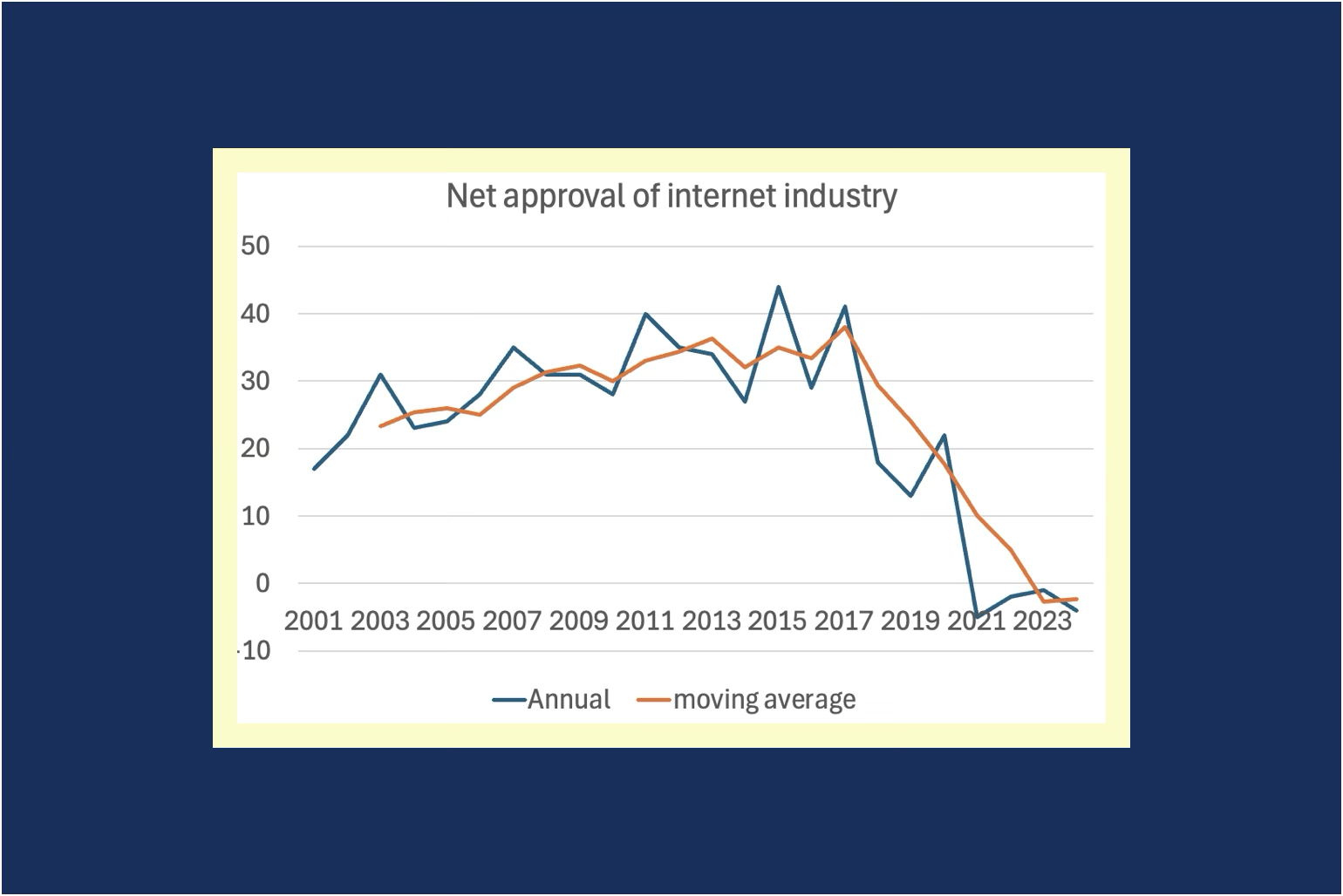
Net approval of the internet is at all time lows. But trust in general is nose-diving. Weirdly, more in rural areas.
Yesterday were the elections here in the Netherlands. We were lucky: the far-right anti-immigrant surge has been tempered. But the weirdest thing, why do the towns and villages vote far more to the right than the cities?
Trust in the internet has collapsed. That’s for reasons you can probably imagine, trash-talking on twitter, deep fakes, untrustworthy AI driving youths to despair.
Trust in government has collapsed during that same period. A study published in the British Journal of Political Science shows that trust has been declining since 2010, with a more dramatic drop since 2017.
And this drop in trust is more pronounced in rural areas than in the cities. The drop in trust in the internet shows the same trend.
For me, having grown up in sparsely populated New Zealand, the Netherlands feels like one big city. A Brit on a business trip once told me that this is a 2 by 4 country: you drive from west to east in two hours, from south to north in four. Greater Los Angeles is more than twice as big.
The Netherlands is patches of green in between cities. But still.
Studies find that rural areas are more receptive of anti-immigration policies. Strange, because most immigrants live in the cities. But it’s true: people distrust what they don’t see firsthand. In villages where virtually no immigrants live, most vote for anti-immigration parties, while villages that have embraced immigration, being dependent on labour for harvest, do not.
There’s also correlation between trust in internet and density of mobile internet towers. As with so many services, internet connectivity is far more advanced in cities than in rural areas. Not only is the density of mobile towers greater, but it’s in cities where cutting edge broadband connectivity is first rolled out.
The internet is more distrusted in the villages partly because it’s physically less trustworthy. It’s also perceived to be less trustworthy because of its content. Studies show that people in rural areas experience a cultural mismatch because content is largely tailored towards urban audiences.
Ok, but we still don’t know why there is a marked drop after 2017 in both trust in the internet and trust in government in general.
Researchers say the key drivers are populist leaders and parties, attacking government as corrupt, elitist, or out of touch. Amplified by their social media rants against anyone and anything. They feed on an intrinsic feeling of uneasiness, which is more pronounced in rural areas partly because the people who choose to stay tend to shy away from change, more than their children, who have moved to the cities in search of adventure.
Here in the Netherlands, we went through the eye of the storm. But not unscathed. As of right now, the difference between the anti-immigrant party and the centrists is but a couple of thousands of votes. A long slog will follow to build our next government.
Hopefully they will stay around longer than the last lot. They've their work cut out for them. Build trust, in government. In the internet.