The Demise of Copyright and IP is a Matter of Statistics.
There’s eight billion of us. We all eat from the trough of combined human knowledge. Process it with the same brain. Exponentially accelerated with AI.
What’s the chance of an individual coming up with something truly unique?
I would say near zero.
Copyright is a contract assigning an invention to an individual, enforced by the power of law.
History is littered with examples of simultaneous, independent discoveries and inventions. Newton and Leibniz both invented calculus and also around the same time. Both leaning on mathematics that had started with the Arabs, Greeks and Egyptians.
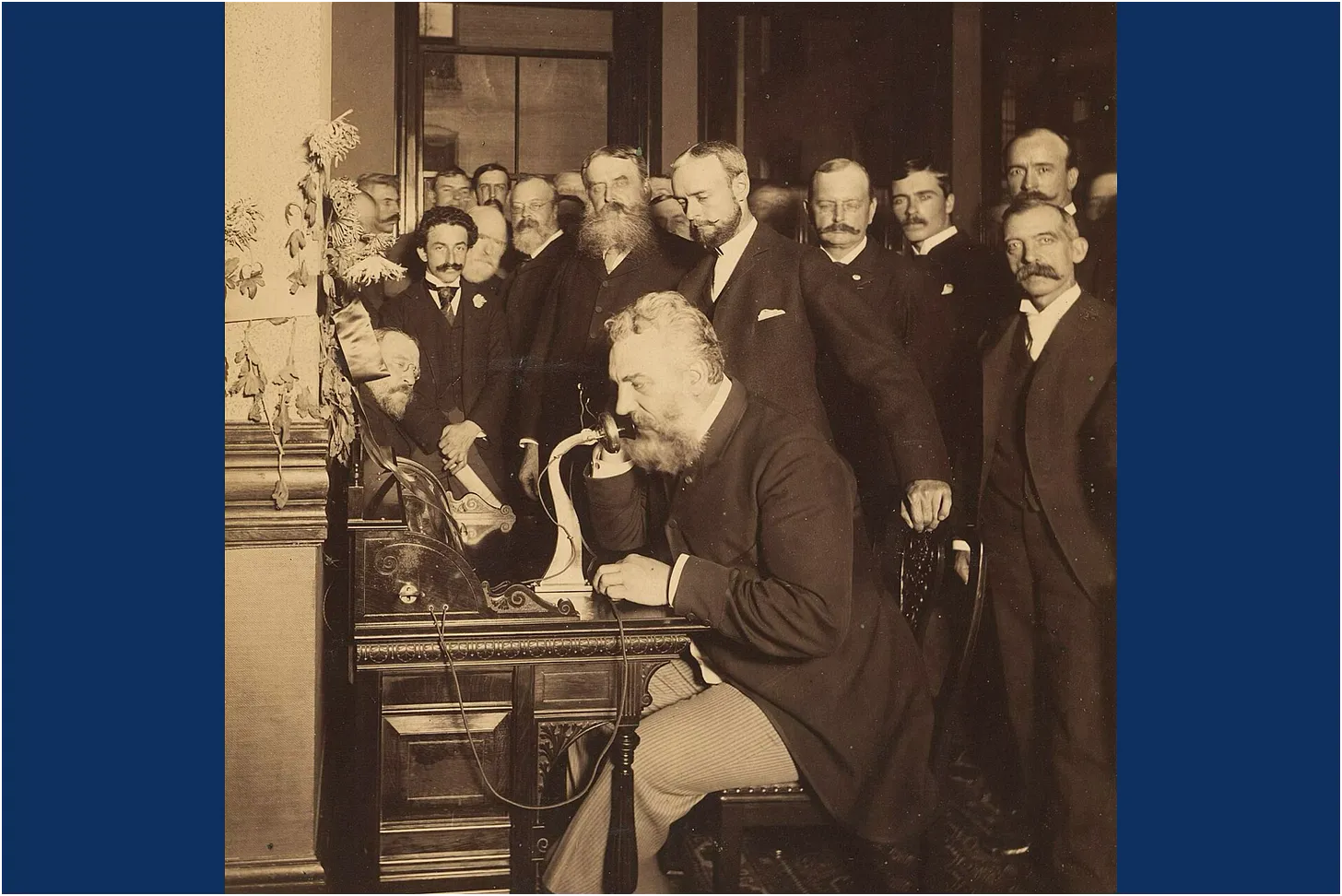
The telephone was invented by Alexander Graham Bell is what’s in the history books, but in reality, a plethora of 19th century scientists were working alongside each other: Charles Bourseul in Belgium, Antonio Meucci in Italy, Johann Philipp Reis in Germany.
It’s said that Elisha Gray was the true inventor because from his brain had sprouted the idea of a component that would prove crucial to the transformation of electric current to a representation of the human voice. But Bell was the first to get his patent approved and the rest is history.
When Patent Law Hurts More Than It Helps.
Patents can verge on the ridiculous, or can be weaponised to stifle competition. Or both. The 1-click ordering system patented by Amazon in 1999 is a standout example.
This patent covered the method of allowing customers to make online purchases with a single click, bypassing the traditional shopping cart and checkout process.
The patent essentially gave Amazon a monopoly on any one-click purchasing method, leading to lawsuits against competitors like Barnes & Noble. It finally expired in 2017, a relief to online shops.
Copyright, intellectual property, patent law. All about assigning originality to an individual or legal entity. But originality is a unique combination of the legacy of human knowledge leading to an artefact that is in some way helpful to humans or maybe even humanity. It takes, and gives back.
There’d Be No Internet Without Sharing Knowledge. And No AI.
In the world of software, open source plays a decisive role. Without open source, there’d be no internet, no AI. No Python, no PyTorch, no TensorFlow. No scikit-learn, no Hugging Face Transformers. Closed source OpenAI is built on open source.
IP is just as arbitrary as the patent that Bell won and Gray didn’t. It’s considered the safety belt in an investor’s vehicle, but the sense of security it gives is false.
Copyright and IP laws were designed for a world where information spreads slowly and creation is a solitary act. The legal system attributing inventions to individuals or corporations is a relic of a pre-digital era.
Enforcing ownership over ideas is arbitrary. Ideas are the product of shared knowledge and tools.
Progress Thrives When Knowledge is Shared, Not Hoarded.
With AI, the pace of idea generation and recombination has reached unprecedented speeds.
Algorithms can now analyse vast datasets, identify patterns, and generate outputs that mimic human creativity. When billions of people and their machines are processing the same information, the likelihood of parallel creation skyrockets.
History shows it’s actually always been that way, but at a slower pace. It’s time to take that to be a fact.
We should develop models that prioritise collaboration over ownership. Open-source software, Creative Commons licenses, and collective innovation pools (like Wikipedia or open science initiatives) demonstrate that progress thrives when knowledge is shared, not hoarded. It’s not for nothing that the most innovative AI models are open sourced.
If copyright is a contract, perhaps it’s time to renegotiate its terms. Should we reward the act of creation, or the act of sharing? Can we design systems that incentivize contribution to the collective trough rather than guarding its edges?
Header image: E. J. Holmes, Alexander Graham Bell, 1892. This silver print was produced from an original shot at the occasion of the first telephone call between New York and Chicago.