The internet: we’ve built our homes, towns and cities there, but where are our cathedrals?
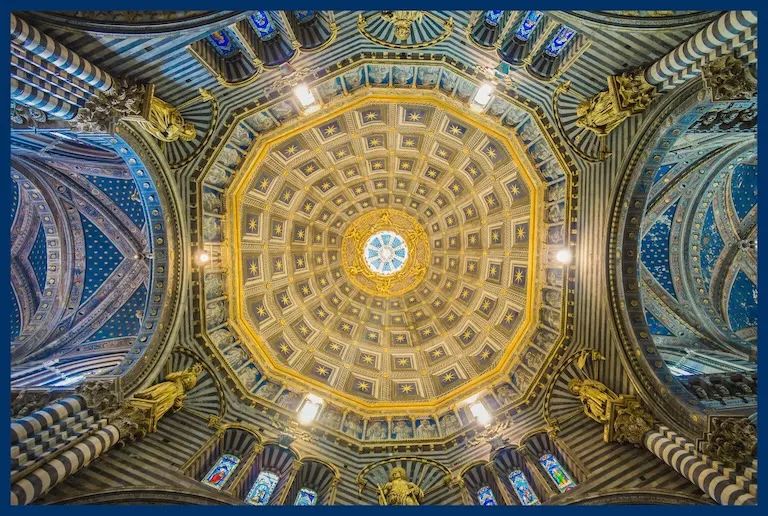
Our internet is a grand suburban sprawl with a couple of hi-rises. But the true, intergenerational store of wealth and community is underground.
We’ve always described a website in terms of books. It has pages, a page has a header and a footer. Obviously, maybe. Because the first websites were representations of the layout of someone’s computer, the files in their folders represented in an index.html.
The homepage. Why “home”? Back to the beginning? Back home? Where you’re born and where your life started?
At our small software company, we build websites. Of course we’d rather say “web applications”, but at family parties you like to keep it simple.
We build complex applications that live on the internet. To call them “books” is a ridiculous misnomer. They have hundreds, sometimes thousands of features, a true microcosm of the outside world, with logistics and inventory, invoicing and payments, enabling inspecting and reporting, categorising and selecting, and more.
But let’s zoom out a bit.
Google is our wayfinder. Yes, I know, there’s Bing as well, and any number of tiny competitors. Or, to preempt our nestling medieval metaphor: you find yourself in a barren landscape, you’re tired, cold and hungry, and desperately want a warm ale, a hearty broth and a warm bed for the night. There’s a wayfinder close by and three others much further away. Who do you ask?
You come to the inn, and are greeted by the keeper. You look around, is it to your liking? There are three others down the road, but this is the closest. There’s a rowdy group in the corner but to the right, there’s even a games room. You decide to stay.
Next morning, you wake early and set yourself to continue your journey. The town is alive with markets and businesses, and towards town centre there’s a huge building arising, but you can’t quite make out what it’s to become. You ask, and learn that a cathedral is being constructed. Now you’re interested. Coming closer you see builders of all trades bustling inside and outside the site: scaffolder monks, stonemasons and carpenters, glaziers, metalworkers of all guilds: knife-makers, locksmiths, chain-forgers, and nail-makers.
Unchallenged, you wander through the immense open structure. A lone worker catches your eye, crouched on a tiny stool, wielding hammer and chisel against brittle stone. Already you can make out the figures which are being cut out by the sculptors hand: our Lady Maria holding the body of the dead Christ.
To build a medieval cathedral is unimaginable in our times.
A medieval cathedral is a splendid but extravagantly redundant architectural wonder, unimaginable in our times, not because we couldn’t build one now, but because we wouldn’t.
The costs were as astronomical as their ambition and determination: in today’s euro’s, the grandest of them all in light and brilliance, Chartres, took an estimated 600 million to a billion to build, renovate, restore from the many fires, from its first version in around 700 until today.
The larger Notre Dame de Paris, which has recently been reopened after being devastated by fire, would have cost more than 5 billion in today’s money.
And that’s nothing. The most expensive building ever constructed is the Great Mosque of Mecca (Masjid al-Haram) in Saudi Arabia, with an estimated total cost of 100 billion euros in today’s money.
As a comparison, the most expensive commercial building to date -- of course in China -- is the New Century Global Center in Chengdu, its cost estimated at somewhere between 8 and 10 billion euros.
If cathedrals were so extravagantly expensive, why were they built?
Yes, they were a symbol of the might of the medieval church, but their centuries long lead time superseded generations of religious and secular functionaries. And at enormous cost. Some estimates say that the build cost upwards of 20% of local GDP. With their multi-generational timeline it must have been more than the petty ego of those in power. So why?
Cathedrals were seen as "heaven on earth", physical manifestations of the divine. Their soaring heights, light-filled interiors, and intricate art were designed to inspire awe and lift the soul toward God. They were works of art embedded in the ultimate work of art, the communal belief system that comprised so much of medieval life: religion.
Communicating that belief not only to the congregation attending masses, but the very existence of the cathedral, rising high above the surrounding village homes, is communicating that something more important is binding us all.
But they were also an enormous stimulus of economic life. That 20% GDP fed not only the workers but fostered the local economy. Cathedrals such as Chartres attracted those on pilgrimage, in fact, many were purposely built near pilgrim routes to facilitate donations to their build and operating costs.
Unlike today, there were few other ways to deploy surplus wealth. Nobles couldn’t invest in stocks or startups; donating to a cathedral was one of the few ways to "store" wealth visibly and piously.
And of course, they were the space race of the Middle Ages. Countless innovations were done to make possible the soaring arches and the mind-dazzlingly huge stained glass windows.
What they also did was to anchor towns around this central location and ambition, towns which would later grow into cities, attract the most brilliant, and grow further into technological hubs and into the megapolis’s of today.
Where then, are OUR cathedrals?
Just today, US secretary of state Rubio, in his speech before the audience of the Munich Security Conference, gave another example of how the USA considers the EU degenerate, with it’s stubborn insistence on democracy, human values and care for the environment.
Ridiculous on so many levels, such rants have already caused a serious rift between erstwhile allies. And they are set to further weaken the already precarious world order.
But if world order was to take on shape, what shape should that be?
I’d argue that our cathedrals, or maybe singular, not plural, our cathedral, will outlast petty differences. I’d say our cathedral is mostly invisible, underground, built across centuries, intergenerational and ambitious, built with the immense determination of our collective minds.
Samuel Morse’s message, "What hath God wrought", was sent from Washington to Baltimore in 1844, and it marked the birth of electrical communication.
The laying of the transatlantic telegraph cable was audacious, risky, and transformative. The first attempt in 1858 failed after just a few weeks, but the 1866 cable succeeded, permanently linking Europe and North America. It was the first step towards our information infrastructure, shrinking the world from weeks to minutes.
The total expenditure on data centres and cloud infrastructure, undersea cables and networking, power and energy infrastructure from 2010 to 2024 was 3 to 4 trillion euros. It’s estimated that the cumulative cost of building and scaling the global information infrastructure is on the order of 5–7 trillion euros over the coming decade, making it the largest infrastructure investment in history.
And that’s not counting Elon who wants to build solar-powered data centres in space.
Communications infrastructure is our cathedral. It ticks all the boxes.
Awe-inspiring scale: Just as Chartres’ spires dominated the medieval skyline, today’s data centres and fiber-optic networks span continents and oceans, connecting billions in real time.
Like cathedrals built over centuries, our digital infrastructure has evolved in layers. From telegraph wires to 5G towers, from ARPANET to the cloud. Each era adds its own, whether it’s AI, quantum computing, or space-based servers.
Cathedrals were both spiritual sanctuaries and bustling civic hubs, the internet is a space for enlightenment and commerce, for democracy and exploitation.
Surviving fires: From the dot-com crash to cyberattacks, from privacy scandals to geopolitical fragmentation, from enemy ships dragging their anchors across the bottom of the sea, the system has faced its share of disasters and reinventions. Each crisis forces us to rebuild stronger, just as cathedral fires led to bolder designs.
It’s a shared human project: No single king, bishop, or corporation "owns" the internet, or the cables and other infrastructure, just as no single king, bishop or guild built Chartres. It’s a collaborative monument, shaped by engineers, policymakers, hackers, and everyday users—each contributing a stone to the structure.
Cathedrals stand the test of time through endurance, self-sacrifice and vision.
And so must we. Our communications infrastructure is the bedrock of the internet, and we base our daily life on its existence. It’s not for nothing that it’s undersea cables that fall victim to rusty Russian rogue ships, dragging their anchors in the hope of snagging one.
We humans are built for communication, and we’ve built intricate systems to further communication. Whether it be to communicate a higher being or to order a nice jersey from an online shop.
Communication means community, community means communication. The lords and nobles, the rich and powerful elite, be they religious or secular, the lowly guild members of the Middle Ages and office slaves of the twenty-first century alike have this doublet engraved in their very being.
Our cathedral is undersea and underground, it’s in immense horizontal industrial buildings, it’s in acres of solar panels as far as the eye can see. There’s a golden web of communication cabling spanning the earth, and who knows, maybe reaching the stars, it’ll let us see light and brilliance, or dark and despair. Up to us.
Header picture: David Siglin on Unsplash