We’re building a highly automated version of our software service company. Solidly centred by real-life people.

We’re making use of AI agents to automate the software development cycle, and our company. So that humans can concentrate on helping our clients succeed.
We’re a small software development company based in Amsterdam. Django people at our core, and with the power of modern frontend at our fingertips, we create unique digital solutions built on the capable and versatile backends that Django makes possible.
We’re Django Web Studio. We build for clients. And for ourselves.
And of course we use AI big time. We’ve been using AI since the betas became available, we’ve been integrating it into all of our work processes, from administration and finance, communication, marketing, to the production of software applications.
But there’s still much to be done. We want to concentrate on product, not on process. Remove repetitive tasks.
More importantly, we’re changing our business model. Because AI is not only increasing productivity, it’s changing the paradigm.
AI coding agents are changing the terrain: the map and the territory have never been closer.
As we’re a full service shop we’ve basically always worked according to the fixed price business model. But there’s a problem with that model.
It’s an ancient problem. One that many software companies will recognise. Or any company, in any industry. Stated simply, it goes like this.
A client asks for a custom product, the company assesses the cost, quotes a number, builds but costs rise, company needs to reassess, client complains that this wasn’t the deal, after long discussions work resumes, finished product not up to par according to client, company doesn’t agree, relationship fails.
The fixed price business model is pretty much standard in many industries. But AI agents are changing the game.
The company takes on a risk for a certain amount of money. In order to do that rationally, the company assesses the impact. Of course. But inevitably, they run into the same, centuries old problem: the map is not the territory. Or, in other words, to assess in increasingly greater detail is to approximate the finished product ever more, and companies can’t afford that. The map remains an abstraction.
AI changes the game radically. The map has now become the prompt, execute the prompt, and the territory appears. The coding agent, in the hands of a senior engineer with highly developed conceptual skills, negates the need for assessment before execution. But this has consequences for the relationship with the client.
Using AI coding agents frees up developers minds to focus on product rather than process.
I could have qualified our senior engineer with other terms. I could have said “cognitive flexibility”, the mental capacity to switch from high-level abstract reasoning to concrete, practical details. I could have said “pragmatic abstraction”, the ability to distill the essence of a problem while ensuring the result remains actionable and grounded in reality.
What I mean is that the engineer understands the business of the client like they do themselves, becomes part of clients business, in spirit, if not in fact.
It’s no longer “I’m the programmer, you need to tell me what to do”. No, programmer, you’re the embodiment of the user, and the client.
As a consequence, you can propose changes to clients products as if you were them. And, with coding agents, because the territory is one button-press away from the map, you should just do it.
So how are we, this small software company sitting in Amsterdam, to respond to this paradigm change?
The emerging paradigm change makes for shifting to a business model that’s as good for clients as it is for software companies.
A traditional fixed price contract is for a distinct product. We would be asked to assess, to quote a number, if client accepts a contract is signed, work is done and delivered. We part our ways.
But often we don’t, because in almost all cases we also take care of hosting the product.
But from hosting comes responsibility for uptime, and from that comes security which means not only server maintenance but also application maintenance and that’s where the model breaks. Because how is client to know what to maintain? And what to budget?
With the fixed price model you’re always arguing. Why does this or that task take so long, what is this change good for, I don’t see anything. You’d give an estimate, it’s four hours, then it turns out it’s six.
You can’t keep giving your clients a free ride, salaries need to be paid.
But now, since the advent of AI coding models and how we’ve embedded them into our work processes, time is no longer of the essence. What’s far more valuable, is that our clients’ products are up to date and as bug free as possible.
So we’re changing to a subscription-based model. Where clients don’t pay their product upfront but commit to a long term contract where everything is included but the largest changes.
Clients don’t have to worry about budgeting maintenance, or do their own security scans. We do all of that. Smaller changes are included, and on top of that, we’re so deeply involved in their business that many changes spring forth from our developers. And because of the paradigm changes brought upon us by the use of coding agents, they’re already done, ready to deploy. Or not, clients choose.
How we ensure that our company is people-first when we use AI for almost everything.
Within the subscription-based model, we take alway a lot of worry. But that comes with responsibility. Because we don’t need to argue about every single nitpicking thing, the work we do for our clients could become even more opaque. How is the client to know what we’re doing for their subscription fee?
We’ll need to design our business system around communication.
The client is at the centre of our world. So obviously, they’re also at the centre of our business system.
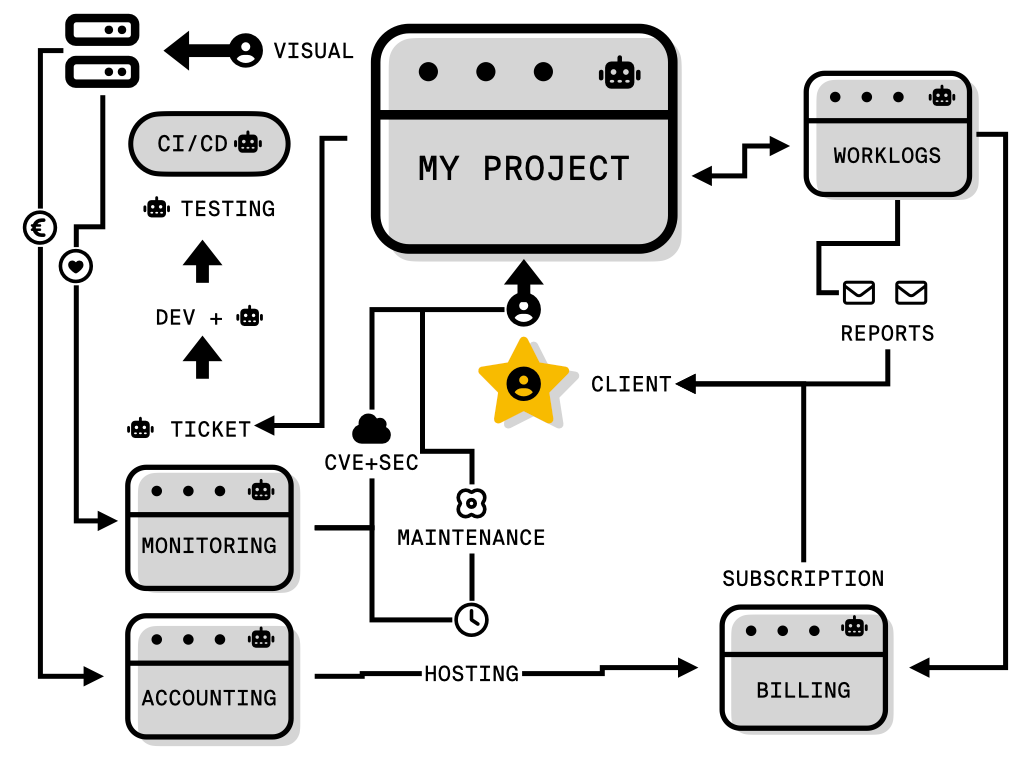
The reporting dashboard is prominently displayed in our diagram. This is where all activity comes together, represented visually in an understandable way. A breakdown of all facets of clients products: hosting, latest tickets, status, including security status.
From this dashboard there will be reports sent out to the client.
We’re already doing this. We have a weekly report, where all activities are listed that we’ve done for the clients products. Then there’s the monthly report, where the security status is presented.
Our AI-powered development cycle looks very traditional but is much faster.
The dashboard is relatively straightforward, it presents tickets, and their status. Clients can edit priority or add a comment, and add a ticket.
A ticket entered will automatically be rewritten by an AI agent. How this will work is that the agent will assess the tickets title and description, go to the projects source code and current production status, and create a rewritten ticket focussed towards the developer.
“Oh”, you might return, “I thought you guys were automating all that?”
Yes we are. But not without human oversight. And insight, for that matter. A developer will be assigned the ticket by the project manager during our daily standups.
When the ticket is assigned, the developer will have the agent read the ticket and start work. The ticket will have status “in development” and this will be reflected in the client dashboard.
Work goes through the different development phases, including automated testing, until it reaches the penultimate stage, just before deployment. The project manager’s task is then to personally validate the ticket’s execution before giving the go-ahead to deploy to production. There it is tested again. Only after a thumbs-up is the ticket set to status done. “Done-done” we say.
This process looks very traditional. But don’t forget, the cycle progresses much faster. In fact, the reason we feel we must adhere to a ticket-based approach is the need to keep communicating during light speed development.
Our responsibility doesn’t end when our work is in production. Production is where our cycle begins.
A substantial part of our work consists of monitoring our production servers, and monitoring the internet at large for any threats to our systems.
Threats from within: server load, or unforeseen consequences of otherwise functioning features.
External threats: security, but less obvious threats such as the unwanted indexing of our clients content.
Our monitoring system assesses the heartbeat of our applications and passes it on to alert systems. We have a dedicated slack channel, and optional automated phone calls, but that’s just the beginning.
When a threat is deemed of sufficient importance, be it internal or external, a ticket will be created automatically by an AI agent, a project manager alerted. We’re already doing this for incoming CVEs.
The ticket then follows our cycle. Using AI coding agents, the threat is resolved in hours, minutes even, not days.
Similarly, we’ve built a number of auxiliary systems that eliminate the need for humans to spend time on trivial tasks. While keeping humans in the loop. Humans have oversight.
We’ve automated our accounting, which feeds directly into our administrative system.
Our worklogs automatically process ticket content to create wording laypeople understand.
There’s more pieces to the puzzle. Core to it all: we have automation and AI do repetitive tasks so we don’t have to.
With AI, we’re building automation so we free up time and cognitive load for the important stuff: people.
The idea behind all this is not that we profit money-wise from the speed gains that AI coding agents bring. That’s a losing game anyway: more than 80% of software developers use AI in their work.
What we’re trying to accomplish with the paradigm change that AI agents bring, is to bind worlds that are still all too often separated by fragmented understanding of each other’s problems and priorities.
For me, the age-old problem of fixed-price contracts is an example of how a business model drives people apart. Gets them into an us-vs-them position they can’t get out of.
I think that this dichotomy, this literal “cutting in two” is bad. Bad for business, bad for our mental health.
Thanks to AI coding agents we’re elbowing ourselves out of the fixed price bind. With our subscription business model we’re devising a way out.
In a world that’s breaking apart so fast that we dare not watch the news, I feel working together works better. Best, even.
Header photo: Vitaly Gariev on Unsplash